 Minstrong Technology Co., Ltd
When selecting a carbon monoxide catalyst for industrial applications, it is not sufficient to focus solely on CO conversion efficiency. Factors such as gas composition, operating temperature, humidity, space velocity, pressure drop, and catalyst lifespan must also be considered. High-purity gas purification systems typically require excellent low-temperature activity and long-term stability, while industrial exhaust treatment systems demand high processing capacity and mechanical durability. For protective equipment and other specialized applications, reliability under complex environmental conditions is equally important. Matching catalyst performance with actual operating conditions is the key to achieving efficient, stable, and cost-effective CO removal.
Why Catalyst Selection Should Not Be Based Solely on Activity
Many projects prioritize CO conversion efficiency when selecting a catalyst. However, actual performance is influenced by multiple factors. A catalyst capable of achieving more than 99% conversion efficiency under laboratory conditions may experience reduced performance when exposed to high humidity, elevated space velocity, or complex gas compositions.
For example, under the same CO concentration, increasing relative humidity from 30% to 80% can significantly reduce the activity of certain catalysts. Therefore, industrial catalyst selection should consider not only catalytic activity but also moisture resistance, structural strength, and expected service life.
Performance Requirements in Different Industrial Applications
Air Separation Units and High-Purity Gas Purification
Air separation systems often require the removal of trace amounts of carbon monoxide to protect downstream processes and maintain gas purity. In these applications, CO concentrations are typically below 1,000 ppm, making low-temperature activity and long-term operational stability critical factors.
Industrial Exhaust Gas Treatment
Industrial combustion processes, metallurgical operations, and chemical manufacturing facilities may generate exhaust streams containing several thousand ppm of CO or more. In these cases, catalyst selection should emphasize processing capacity, resistance to fluctuating loads, and mechanical durability.
Protective Equipment Applications
In confined spaces and personal protection systems, catalysts must rapidly oxidize carbon monoxide into carbon dioxide at ambient temperature while maintaining low airflow resistance and high reliability.
Key Performance Indicators for Catalyst Selection
| Performance Indicator | Typical Range | Primary Impact |
|---|---|---|
| CO Conversion Efficiency | 95%–99.9% | Purification Performance |
| Light-Off Temperature | Ambient–120°C | Low-Temperature Activity |
| Specific Surface Area | 80–200 m²/g | Reaction Contact Efficiency |
| Mechanical Strength | ≥50 N/cm | Service Life |
| Applicable Space Velocity | 3,000–30,000 h⁻¹ | Processing Capacity |
| Expected Service Life | 1–5+ Years | Operating Cost |
These parameters should be evaluated collectively based on actual operating conditions rather than compared individually.
How Catalyst Shape Influences Engineering Performance
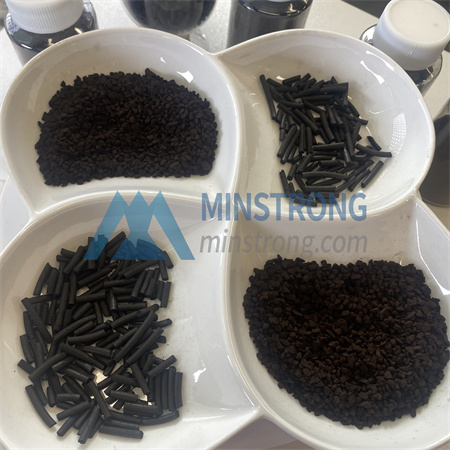
In addition to active components, catalyst geometry plays a significant role in determining system performance.
Cylindrical Pellet Catalysts
Cylindrical catalysts provide excellent mechanical strength and bed stability, making them suitable for large industrial systems operating continuously over long periods.
Irregular Granular Catalysts
Irregular granules generally offer higher specific surface areas and more active sites. However, they also produce higher pressure drops and are typically preferred for small- to medium-scale systems.
Honeycomb Catalysts
Honeycomb structures provide low pressure drop and uniform gas distribution, making them ideal for treating large airflow volumes with relatively low CO concentrations. However, their active surface area per unit volume is often lower than that of granular catalysts.
Typical Catalyst Selection Strategies in Engineering Projects
In one high-purity nitrogen purification project, the system required trace carbon monoxide concentrations to be reduced to extremely low levels. Because the gas stream was clean and flow conditions were stable, a highly active granular catalyst was selected to maximize low-concentration CO removal efficiency.
In another industrial exhaust gas treatment project, large gas volumes and continuous operation were the primary challenges. The engineering design prioritized pressure drop control and mechanical strength, leading to the selection of a structurally robust formed catalyst capable of maintaining long-term operational stability.
Engineering experience shows that there is no universally optimal carbon monoxide catalyst. The best choice is always the catalyst that most closely matches the specific operating conditions. A systematic evaluation of gas composition, process requirements, equipment design, and service life expectations is essential for achieving the optimal balance between CO removal efficiency and operating cost.
author:kaka
date:2026/6/24
WeChat
Scan the QR Code with wechat