 Minstrong Technology Co., Ltd
Ozone catalysts rely primarily on surface active sites and porous structures to achieve efficient ozone decomposition. Their catalytic activity, reaction efficiency, and lifespan are highly dependent on surface state and structural integrity. High humidity weakens the catalytic effect from multiple dimensions, including physical, chemical, and structural aspects, and can even cause irreversible deactivation. Therefore, pre-humidification is essential in practical applications to ensure long-term stable operation of the catalyst.
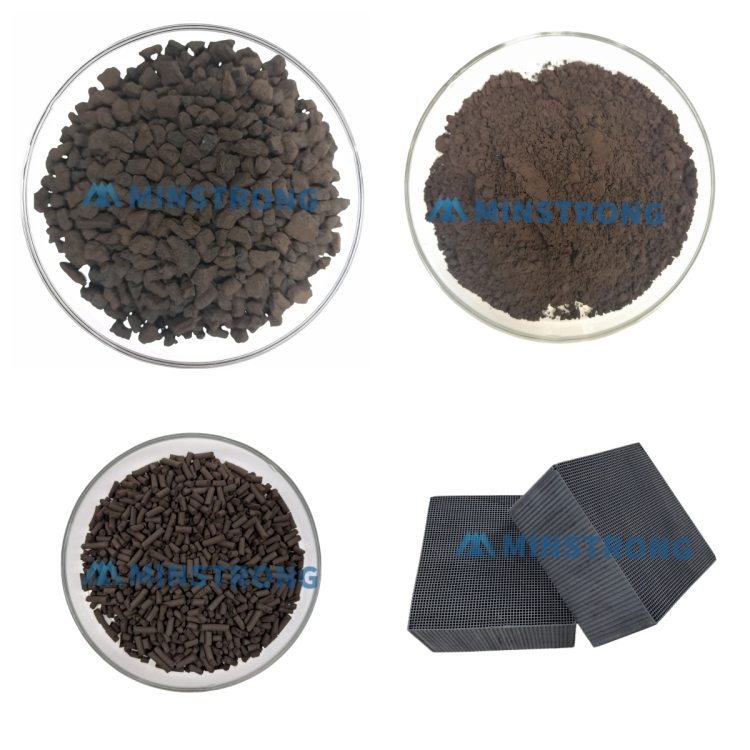
Under high humidity conditions, water vapor preferentially adsorbs onto the catalyst surface, forming a dense water film that directly occupies and shields the active sites. Ozone molecules cannot effectively contact the active components, leading to the interruption of the adsorption-activation-decomposition catalytic chain, resulting in a significant decrease in ozone removal rate. As humidity increases, this competitive adsorption effect becomes more pronounced. Even if the active components themselves are not damaged, the number of effective sites participating in the reaction will be greatly reduced, which is the most direct reason why humidity affects performance.
Simultaneously, moisture alters the chemical environment of the catalyst surface, interfering with reaction pathways and reducing redox efficiency. Water molecules can interact with reactive oxygen intermediates produced during ozone decomposition, consuming intermediate products and reducing the efficiency of ozone conversion to oxygen. Prolonged high humidity can cause hydration and dissolution of some metallic active components, leading to changes in the active phase structure and a continuous decline in catalytic activity. This effect not only reduces immediate treatment efficiency but also gradually weakens the overall performance of the catalyst.
Long-term operation under high humidity conditions can also cause problems such as pore blockage, structural collapse, and decreased strength in the catalyst. Catalyst supports are mostly porous materials, and continuous water absorption easily leads to pore expansion and pulverization, significantly reducing the specific surface area. Under alternating hot and cold conditions, repeated evaporation and condensation of moisture exacerbate support cracking and pulverization, ultimately leading to catalyst failure. Furthermore, high humidity environments easily combine with particulate matter and organic matter in exhaust gases, forming viscous deposits on the catalyst surface, further blocking pores, exacerbating catalyst poisoning, and significantly shortening its lifespan.
Therefore, the impact of high humidity on ozone catalysts is a comprehensive result of decreased efficiency, performance degradation, and shortened lifespan. To ensure efficient and stable catalyst operation and extend its lifespan, front-end dehumidification is an essential and crucial measure. Reducing the humidity of the incoming air decreases the competitive adsorption of water molecules on the catalyst surface, protecting active sites and maintaining high catalytic efficiency. Simultaneously, it prevents the support from absorbing water and swelling, causing structural damage, reducing pore blockage and deposit formation, and significantly delaying catalyst aging. A well-designed dehumidification system allows the catalyst to operate under optimal conditions, improving ozone decomposition efficiency, reducing replacement frequency, and enhancing the overall system's economy and reliability.
author:kaka
date:2026/3/4
WeChat
Scan the QR Code with wechat